Music theory is vital to any guitar player that is looking forward to a long-term hobby or even profession. The majority of young guitarists decide to skip music theory, and instead start learning tablature of idolized bands. This is often a bad idea for a number of reasons, and is usually better to learn music theory first- however “less fun” it might be, since it will be a phenomenal help in the long run.
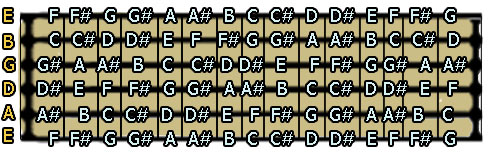
Figure 1 – It might not look like a fretboard, but it is! Don’t worry if it looks confusing- it’s actually quite simple. Learning music theory is vital to the avid guitarist!
To start off, the guitar is almost always a six string instrument, divided into 21 or 22 frets. The guitar is tuned low from high, represented by the letters E-A-D-G-B-E. Each letter represents a different string, with the first E being the thickest gauge wire, and the last E being the thinnest. The first E string is commonly referred to as the “low E string”, and the last one is referred to as the “high E string.”
You will notice that each letter, from A to G, has a seemingly complex ordering system. The notes are arranged by pitch up to the twelfth fret, and then the octave starts over. Anything twelve frets apart from one note can be said to be an octave higher or lower. Octaves are simply the same note in a separate pitch. See the below example:
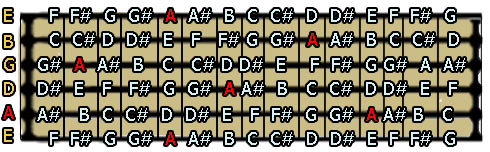
Figure 2 – Notice how the highlighted “A” nte appears more than once! (Also keep in mind that the open “A” string counts too!) These are the same notes, just octaves apart!
The arrangement of pitch makes it easy to produce pleasing sounds in standard tuning with little effort. Separate tunings, such as Drop D tuning, reduce the low E string by a full octave. Can you guess what this would do to the fingerings of a simple chord in standard tuning? It would make it as easy as holding down the top three strings to form a chord! This is the standard for many rhythm guitarists, as it makes it even easier shift chords, not to mention doing so much faster.
Since all frets are arranged according to octaves, each fret is technically a half step increment, and is part of the chromatic scale. You may have become familiar with some music theory terms, and heard the term “flat” or “sharp.” This is simply a note that is a half step closer to the next note, but isn&rsquot quite either note. You could replace all the “#” symbols in Figure 1 with the “flat” symbol of the next letter. On the first string, the “F#” (F sharp) is also a “Gb” (G flat).
That concludes your first lesson in Music Theory! Now for some homework; you need to be able to memorize every note on the fretboard! Don’t worry, it isn’t as impossible as it seems, and knowing every pitch on the fretboard will payout in the long run many times over. Practice this same-note training exercise to train yourself, at least once a day with different notes until the entire fretboard is memorized:
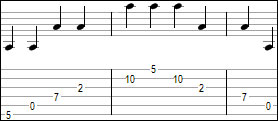
Figure 3 – Notice that this is the same note, the “A” note. Just different octaves! You can download the GuitarPro 5 file here: Pitch Practice